




The Purple-crested Turaco, The Croaking Ghost of the Forest Canopy
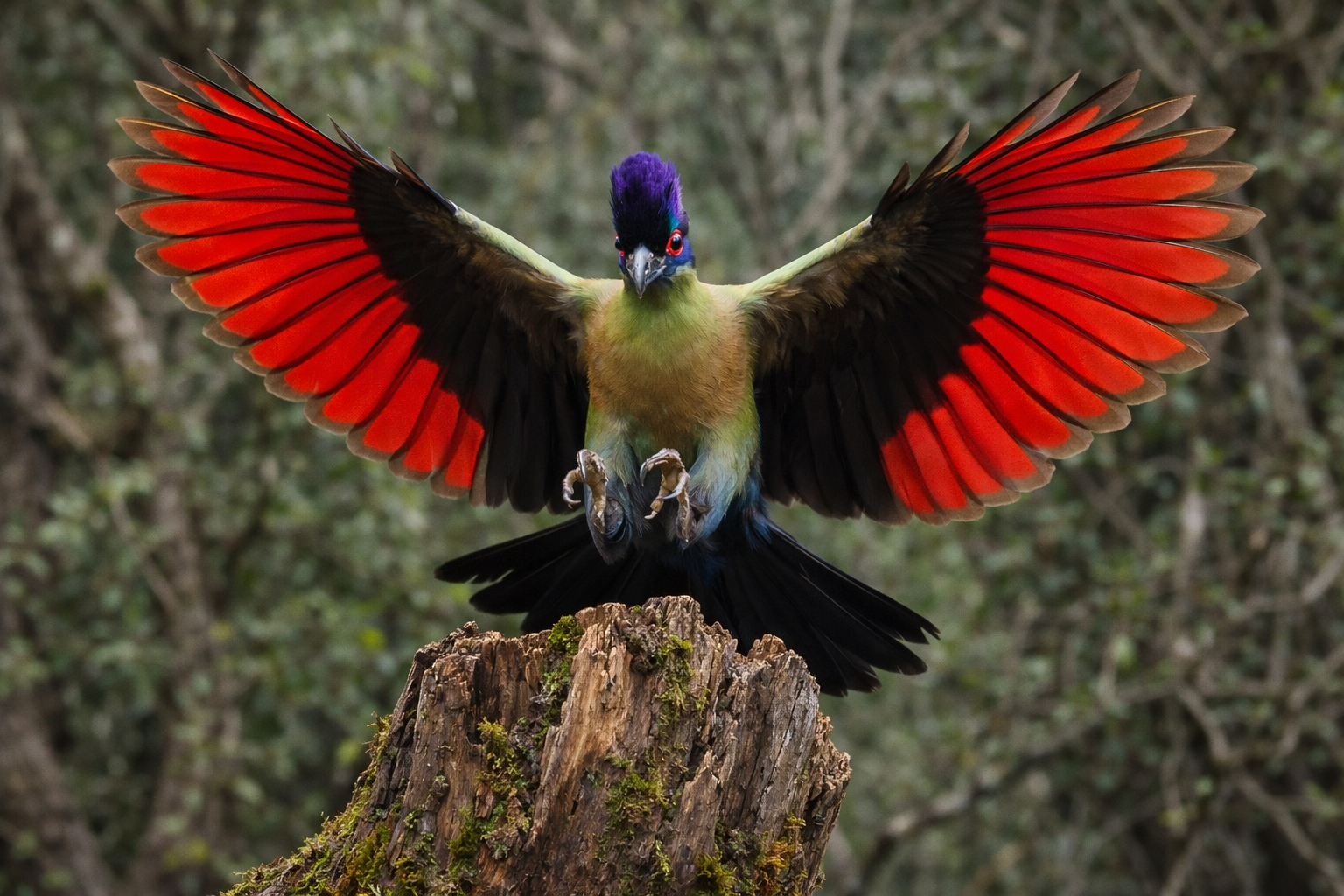
If you have spent any time in the African bush, especially in riverine forest or dense woodland, you will almost certainly have heard it. A deep, rolling, croaking call that sounds completely out of place. Guests stop mid-sentence, tilt their heads, and ask the same question almost every time.
“Was that a monkey?”
Or sometimes,
“Is that a frog?”
Very few people expect the answer to be, “No, that was a bird.”
And fewer still expect that the source of this strange, guttural sound is one of the most striking and colourful birds in southern Africa, the Purple-crested Turaco. This bird is not just a visual surprise, it is an acoustic one too. Elegant, almost regal in appearance, yet producing a call that sounds more like something from a swamp or a primate troop, the Purple-crested Turaco is a perfect example of how the African bush still has the power to surprise us.
A Bird You Hear Long Before You See
The Purple-crested Turaco is far more often heard than seen. It lives mostly high in the canopy, moving through trees with a quiet confidence that makes it surprisingly hard to spot despite its size and colour. Its call is unmistakable once you know it. A series of deep, resonant “kow-kow-kow” notes, often delivered in a rhythmic sequence, sometimes answered by another turaco further down the forest. The sound carries extremely well, especially in still morning or late afternoon air, which is why guests are often convinced the call is coming from something much larger. What makes this even more confusing is that the turaco rarely calls while sitting still. It often vocalises while moving through the trees, so the sound seems to shift and echo, adding to the mystery.
Once you finally see the bird, the contrast between sound and appearance is startling. This is not a dull, camouflaged forest bird. This is something else entirely.
A Splash of Colour in the Canopy
At first glance, the Purple-crested Turaco looks almost unreal.
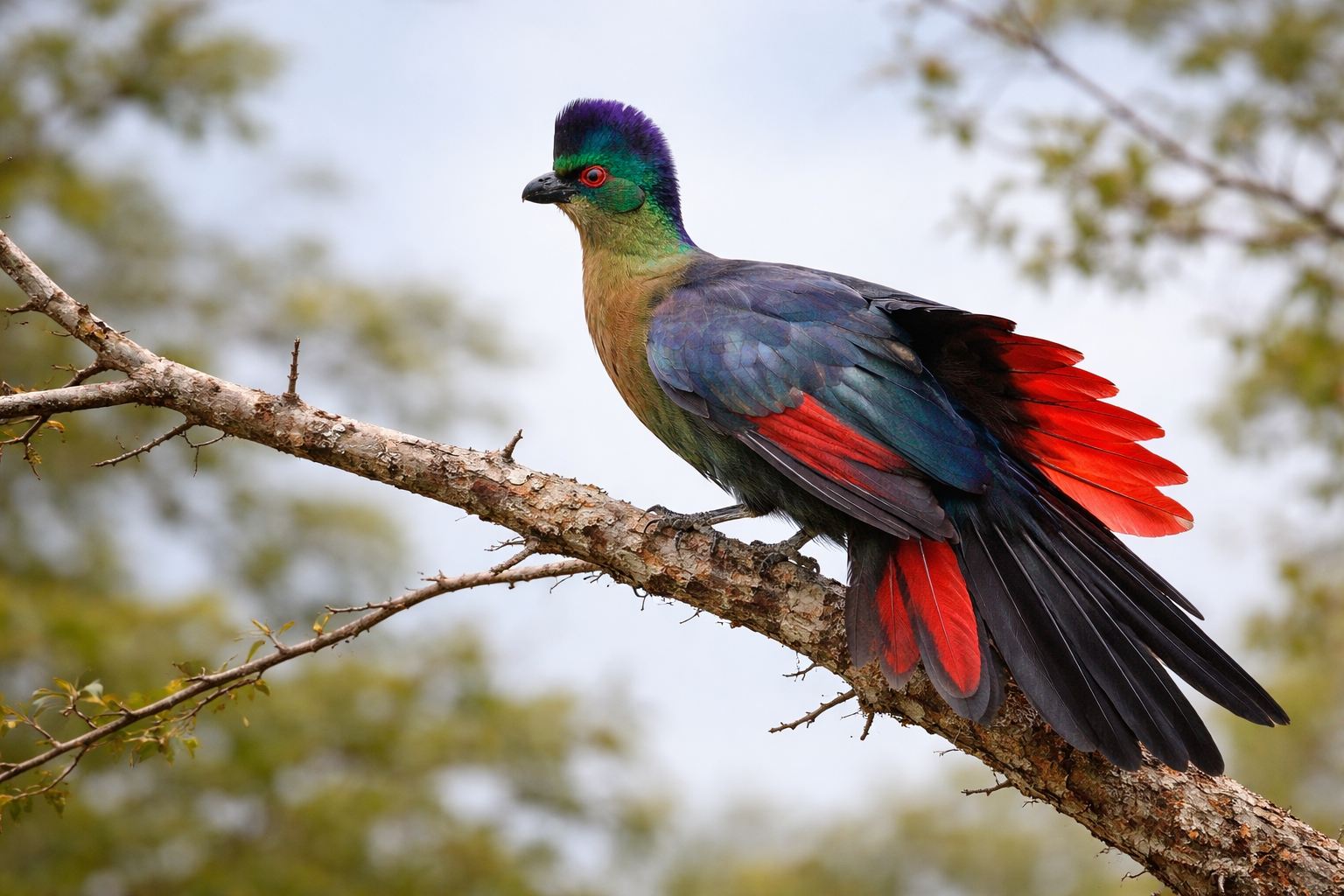
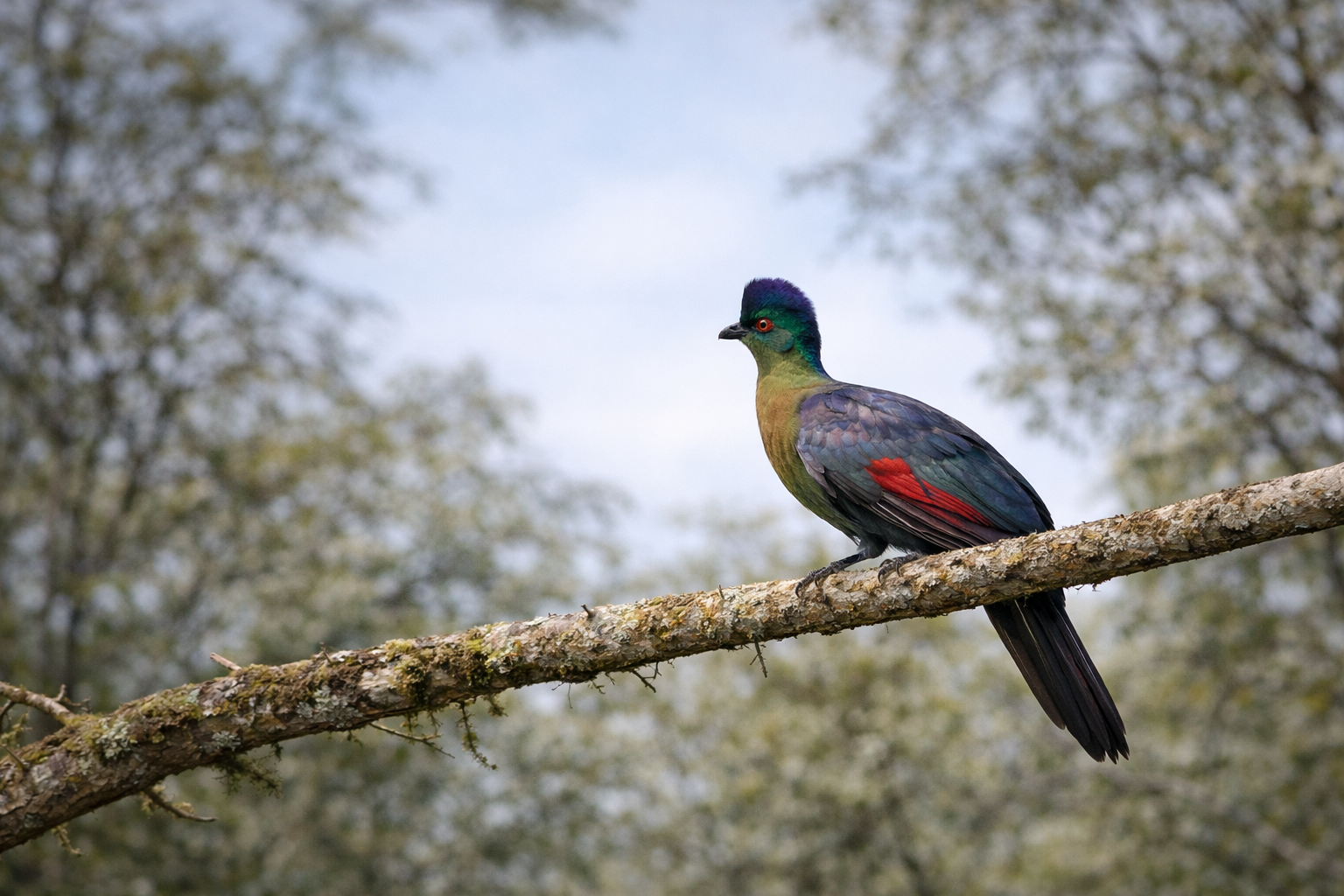
Its plumage is a rich blend of greens, blues, and purples, topped with a distinctive purple crest that gives the bird its name. The eye is encircled by a bold red eye-ring, which adds to its slightly intense, almost prehistoric look. But the real showstopper only reveals itself in flight.
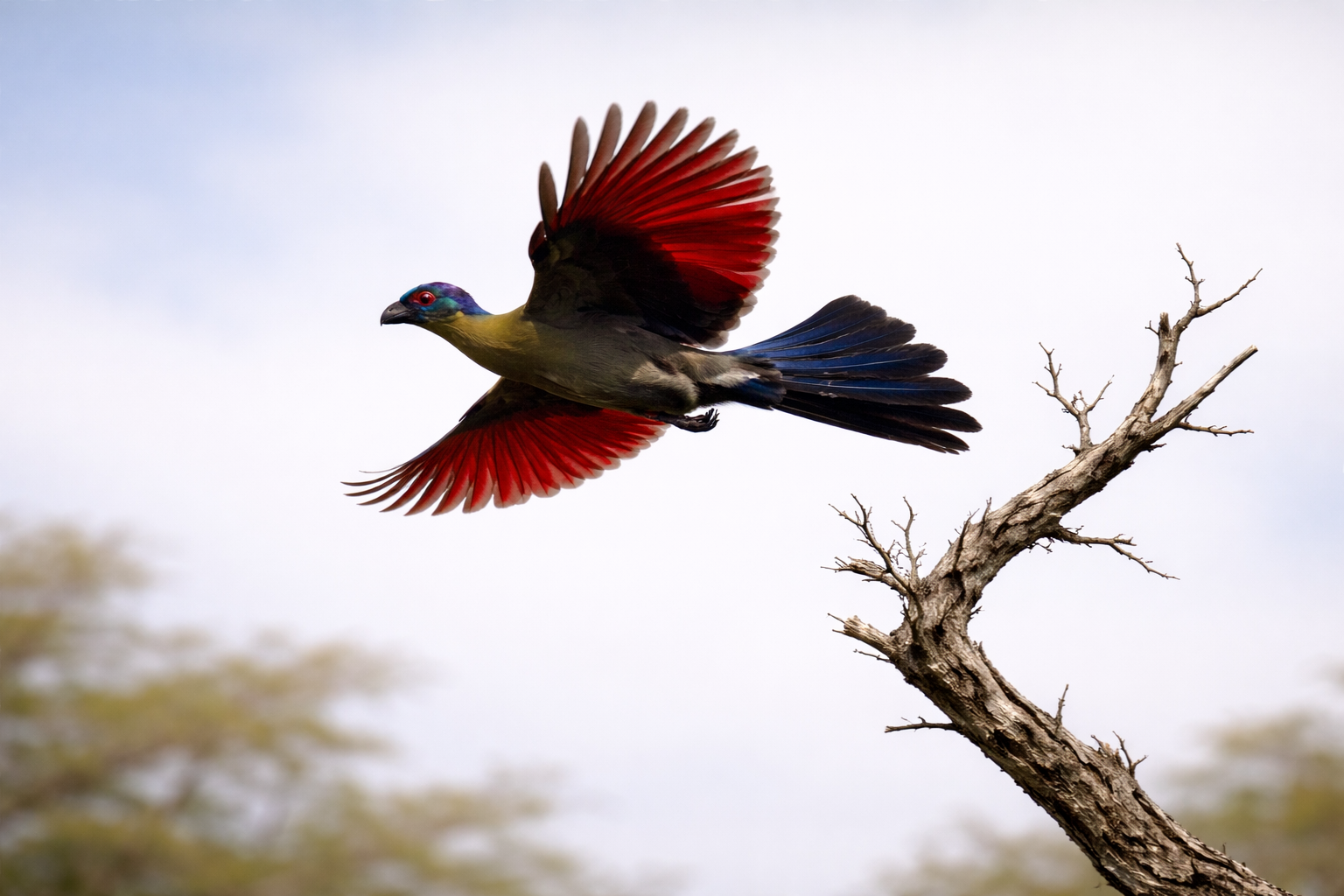
When the turaco opens its wings, brilliant crimson flight feathers flash into view. These red feathers are not subtle. They are bold, luminous, and completely unexpected. It is often this sudden burst of red that finally gives the bird away as it launches from one tree to another. Many guests describe their first turaco sighting as a moment of genuine surprise, a flash of red where no red should be.
The Science Behind the Colour, Why Turacos Are Truly Unique
The name “turaco” is not just a name, it is a scientific clue. Turacos are the only birds in the world that produce two unique copper-based pigments in their feathers, turacin and turacoverdin. Turacin is responsible for the vivid red colour in the wing feathers, while turacoverdin gives the bird its rich green tones. Unlike most green birds, whose colour comes from feather structure reflecting light, turacos are actually green because of pigment.
This makes their coloration truly unique in the bird world.
Even more fascinating is the fact that turacin contains copper. Early scientists were so intrigued by this that they famously washed turaco feathers and watched red pigment leach out into the water, something that simply does not happen with most bird feathers. Despite containing copper, these pigments are not toxic to the birds. They are a natural and harmless part of turaco biology, evolved over millions of years.
Not Built for Long Flights, But Perfectly Designed for Trees
Although the Purple-crested Turaco is a strong flier over short distances, it is not a bird of open skies. It is built for life in trees. Its wings are broad and rounded, ideal for short bursts of flight between branches. Its long tail acts as a stabiliser, helping it manoeuvre through dense foliage with precision. The feet are equally specialised. Turacos have a semi-zygodactyl foot arrangement, meaning two toes can face forward and two backward when gripping branches. This gives them excellent balance when clambering through the canopy, hopping, climbing, and running along branches with surprising agility. On the ground, however, they are awkward and vulnerable, which is why they rarely descend unless forced to.
A Diet of Fruit, Flowers, and Forest Favourites
The Purple-crested Turaco is primarily a frugivore, feeding mainly on fruit. Wild figs are a particular favourite, and wherever there are fruiting fig trees, turacos are often nearby. They also eat berries, soft fruits, flowers, and occasionally leaves. Insects form only a very small part of their diet, usually taken incidentally rather than actively hunted. Because they move frequently between trees and consume large amounts of fruit, turacos play an important role as seed dispersers. Many forest plants rely on birds like turacos to spread their seeds across the landscape, helping maintain healthy woodland ecosystems. In this way, the turaco is not just a beautiful bird, it is an important ecological partner.
Habitat, Where You Are Most Likely to Find Them
Purple-crested Turacos favour well-wooded areas. In southern Africa, this includes riverine forest, coastal forest, dense woodland, and mature bush with tall trees. They are particularly fond of areas with a good supply of fruiting trees and access to water. This is why they are often encountered near rivers, drainage lines, and forest edges. They are not migratory birds and tend to remain within a fairly stable home range, which is why guests staying for several days may hear the same individuals calling repeatedly from the same general area.
Once you learn their call, it becomes a familiar soundtrack to mornings and evenings in the bush.
Breeding and Family Life
Turacos are generally monogamous and form long-term pair bonds. Breeding usually coincides with periods of higher fruit availability, ensuring that adults can feed their chicks adequately. Nests are simple platforms made of sticks, placed high in trees and well hidden among foliage. Both parents take part in incubating the eggs and feeding the chicks. Young turacos are surprisingly agile and can climb through branches well before they are capable of sustained flight. Like many forest birds, secrecy and canopy cover are their primary defence against predators.
A Bird That Rewards Patience
The Purple-crested Turaco is not a bird you chase. It is a bird you wait for.
Sit quietly near fruiting trees, especially early in the morning or late afternoon. Listen carefully. Watch for movement high in the canopy. Eventually, you may catch a glimpse of green and purple shifting through the leaves. And if you are lucky, you will see that flash of red as the bird launches into flight, revealing the full splendour of one of southern Africa’s most remarkable forest birds.
Once seen and heard, it is never forgotten.
By: Peter Breedveld
3 Comments
Hi Peter, a great newsletter, very interesting about the purple-crested turaco. And what a photo, it must rank as one of the most beautiful birds. Well done great article.
Symbiosis as a business model …….was rather like the curate’s egg…… but we are getting there.
Neil
“Sit quietly near fruiting trees, especially early in the morning or late afternoon”… just that sounds wonderful. But seeing and photographing this beautiful bird would be magnificent. I remember we got a tiny glimpse of it when we were in Sigurwana the last time, but the moment passed way too quickly. Next time…?!
What a lovely story about this very special bird. Hopefully many Sigurwana guests get a glimpse of this beauty!